









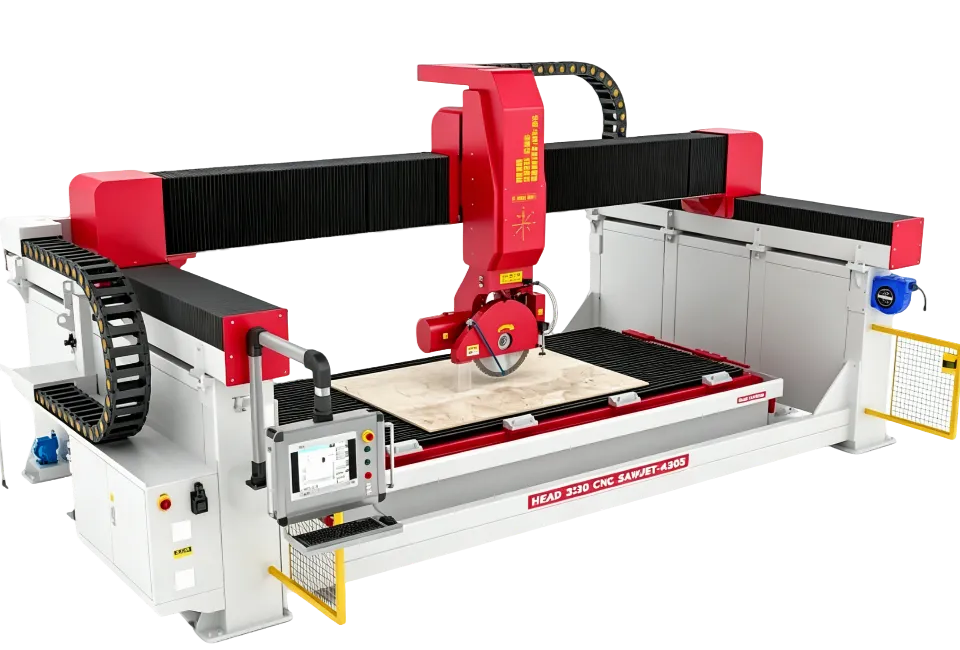
A 5-axis CNC bridge saw combines the rigid structure of a bridge saw with programmable blade rotation, blade tilt, and multi-axis positioning. For countertop plants and architectural stone fabricators, it can replace several manual setups, produce repeatable miters, and move jobs from digital templates to finished parts with fewer handling steps. However, the label “5-axis” alone says little about real productivity. Machine geometry, software, spindle performance, table design, service capability, and the materials in your order book determine whether the investment will perform.
What Is a 5-Axis CNC Bridge Saw?
A conventional bridge saw moves a diamond blade across a slab on a rigid beam. A CNC version adds servo-controlled motion and programmable coordinates. In a five-axis configuration, the machine normally controls longitudinal bridge travel, transverse cutting-head travel, vertical blade movement, head rotation, and blade tilt. Axis names vary by manufacturer, but the manufacturing purpose is consistent: position the blade anywhere within the working envelope and orient it for straight, angled, and compound cuts.
The rotating head allows the saw to change cutting direction without manually repositioning the slab. The tilting axis enables bevels and miters, often from vertical cutting to 45 degrees or more. Coordinated control can produce inclined cuts, polygonal parts, shower components, cladding pieces, and countertop details. Some systems also support a small routing tool, drilling spindle, vacuum lifter, camera, or automatic table functions. These additions can expand capability, but they should be evaluated as separate production tools rather than assumed benefits of the five-axis label.
For a broader comparison of available machine categories, see how to choose the right machine for precision stone cutting. The central question is not whether five axes are technically impressive; it is whether they remove bottlenecks in the factory’s real workflow.
Why Fabricators Invest in Five-Axis Cutting
The strongest business case is setup reduction. With a manual or basic bridge saw, an operator may rotate the slab, reset stops, mark geometry, and make several independent cuts. A five-axis bridge saw can read a digital program, rotate the head automatically, and complete multiple orientations in one setup. That reduces non-cutting time and limits errors caused by manual measurement.
Repeatability is another advantage. Production of islands, vanities, backsplashes, mitred edges, and architectural panels often requires parts from multiple slabs to fit together. Servo positioning and stored programs make repeat orders more consistent. Digital records also help supervisors trace a result to a drawing, tool, speed, and operator decision.
Labor efficiency does not mean unattended production in every case. Loading, slab inspection, suction-cup placement, offcut management, tool checks, and quality verification still require trained people. The value is that skilled labor is applied to process control and finishing instead of repeated marking and repositioning.
Common Applications in B2B Stone Fabrication
Countertops and islands
A 5-axis bridge saw for stone is frequently used to rough-cut kitchen worktops, islands, vanity tops, and commercial counters. The head rotates between cuts, which is useful when nested parts have different orientations. Programs can include straight sizing cuts, diagonal corners, seam preparation, and relief cuts before sink processing. Plants producing quartz, granite, marble, and sintered materials can standardize the first cutting stage across a mixed order book.
Miters, bevels, and laminated edges
Automatic tilt control is valuable for 45-degree miters and other bevels. The machine must hold the commanded angle under load, and the blade must remain stable across the full cut. A nominal 45-degree setting is not enough: the resulting joint depends on axis calibration, blade condition, material flatness, feed rate, and allowance for adhesive. Buyers should test long miters on the materials and thicknesses they sell.
Architectural panels and dimensional components
Façade panels, stair treads, wall cladding, thresholds, and floor patterns often involve repeated dimensions or angled geometry. CNC programming reduces variation across batches and simplifies remakes. For contract work, consistent identification and nesting are especially important because parts may be installed in a defined sequence.
Sink cutouts and curved work
A bridge saw can plunge, step-cut, or use incremental passes around a rectangular cutout. True curves are more demanding. Some machines use blade interpolation, while others add a routing spindle or finger tool. Buyers should not assume that every five-axis saw can finish an undermount sink to installation quality. Define whether the target is rough opening, near-net profile, or fully finished edge, then confirm the tooling and cycle time for that result.
Understanding the Five Axes
| Motion | Typical purpose | What to verify |
|---|---|---|
| Bridge travel | Moves along the table length | Usable travel, rack protection, acceleration, and repeatability |
| Carriage travel | Positions the head across the bridge | Bearing support, cable routing, lubrication, and full-width accuracy |
| Vertical travel | Controls cutting depth and clearance | Maximum thickness, blade clearance, probing, and collision limits |
| Head rotation | Changes the direction of cut | Rotation range, shortest-path logic, cable management, and positioning accuracy |
| Blade tilt | Produces miters and bevels | Tilt range, rigidity at 45 degrees, calibration method, and compensation |
Ask the supplier whether all five motions can be interpolated simultaneously or whether some are positioning axes used before a straight cut. Both architectures can be suitable, but they support different geometry. Simultaneous interpolation matters for compound profiles; indexed positioning is normally sufficient for straight miters and rotated cuts. The specification and demonstration should use precise language.
4-Axis vs 5-Axis Bridge Saw vs Waterjet
| Equipment | Best suited to | Primary strength | Important limitation |
|---|---|---|---|
| 4-axis CNC bridge saw | Straight sizing and rotated cuts | Efficient, relatively simple production | Limited automated bevel capability |
| 5-axis CNC bridge saw | Sizing, miters, angled parts, mixed countertop work | Flexible blade orientation with fewer setups | Blade kerf and geometry limit fine internal contours |
| Гідроабразивна обробка | Intricate contours, tight internal radii, fragile materials | No heat-affected zone and high geometric freedom | Abrasive, pump maintenance, water treatment, and slower straight roughing in many cases |
| CNC machining center | Profiling, drilling, polishing, and finished sink edges | Multi-tool finishing capability | Higher tooling complexity and different throughput profile |
These technologies are often complementary. A bridge saw quickly removes large sections and makes long straight cuts; a waterjet handles internal corners and detailed contours; a machining center finishes profiles and holes. Our guide to waterjet versus bridge saw workflows explains how plants can divide work between processes rather than forcing one machine to perform every task.
Critical Mechanical Specifications
Bridge and frame rigidity
Cutting force travels from the blade through the spindle, head, carriage, bridge, columns, and foundation. Deflection anywhere in that chain can appear as taper, edge wander, miter inconsistency, or vibration marks. Compare machine mass and structural design, but also request test parts. A heavy frame is useful only when bearing arrangement, fabrication, machining, and installation maintain alignment.
Cutting envelope and table geometry
Published travel is not always equal to usable slab capacity. Head rotation, tilted blade clearance, guards, vacuum lifter position, and table edges may reduce the practical envelope. Send the supplier your largest slab and part drawings. Confirm whether the saw can complete perimeter cuts without moving material and whether a miter near the table boundary creates interference.
Spindle power, torque, and blade range
Motor kilowatts alone do not predict cutting performance. Torque curve, gearbox design, spindle speed range, blade diameter, arbor condition, cooling, and allowable duty cycle all matter. Engineered quartz, dense granite, porcelain, marble, and ultra-compact surfaces require different blades and process windows. Ask for recommended feed, depth of cut, blade specification, and measured amperage on each priority material.
Servo system and motion components
Check servo brand, feedback method, gearbox backlash, rack-and-pinion quality, linear guide sizing, and protection from slurry. Absolute encoders can simplify restart procedures, while well-designed limit and home systems support safe recovery. Components should be accessible for inspection without dismantling major structures.
Table, Loading, and Material Handling Options
A fixed table is simple and rigid. A hydraulic tilting table helps load slabs from an A-frame. A rotating or tilting worktable may extend access for certain cuts, although additional mechanisms introduce calibration and maintenance points. Rubber or replaceable support surfaces should resist water, slurry, and blade contact.
Integrated vacuum lifting can reduce manual crane movements and help reposition pieces. Evaluate maximum load at the actual extension and orientation, not only the headline capacity. Vacuum zoning, pad condition monitoring, surface porosity, moisture, and safety interlocks affect reliability. No lifting function should be used without a documented risk assessment and trained operators.
Material flow around the saw can determine output more than cutting speed. Map the route from slab storage through inspection, loading, cutting, offload, finishing, and remnant storage. The article on slab handling and material flow automation provides additional planning considerations.
Software, CAD/CAM, and Digital Workflow
The CNC bridge saw buying guide should give software equal weight with hardware. The operator needs a reliable path from digital template or CAD drawing to nested parts and machine code. Confirm supported file formats, drawing cleanup tools, automatic lead-ins, cutting-order optimization, collision checking, remnant management, labeling, and job reporting.
A camera system can capture the slab surface so the programmer positions seams, cutouts, and visible features. Image accuracy depends on calibration, lighting, lens correction, camera height, and a stable relationship between image coordinates and machine coordinates. Test vein matching with two or more adjoining parts rather than judging the camera only by image quality.
Nesting should respect blade kerf, minimum web size, cut sequence, material defects, grain direction, and handling constraints. Maximum theoretical yield is not always the safest plan. Narrow strips may move after stress release, and early perimeter cuts can reduce support for later parts. See slab nesting optimization for CNC cutting for practical trade-offs between yield, stability, and throughput.
Ask whether software licenses are perpetual or subscription-based, how many programming seats are included, and what happens if remote license validation is unavailable. Confirm post-processor ownership and the procedure for software updates. A factory should retain access to its production files and be able to restore the system after a computer failure.
Accuracy, Calibration, and Quality Control
Positioning repeatability and finished-part accuracy are related but not identical. Thermal change, blade deflection, tool wear, table condition, material movement, and measurement technique affect the result. Request a written acceptance test that defines material, thickness, blade, geometry, measurement instruments, tolerances, and sampling method.
Calibration should cover axis squareness, bridge alignment, head rotation, tilt angle, spindle runout, blade diameter compensation, camera coordinates, tool offsets, and table reference. Operators need a controlled method to verify these items after a collision, blade change, software update, or major service.
Quality control works best when tolerances are assigned according to function. A rough blank does not need the same criteria as a visible seam or long miter. For inspection planning, consult stone cutting tolerances and quality control.
Tooling, Coolant, and Material-Specific Parameters
Diamond blade selection must match material, thickness, spindle power, and edge requirement. Segment bond, concentration, rim design, core stiffness, diameter, and dressing practice influence speed and quality. Track blade life by material and meters cut rather than by calendar time. A low-cost blade that requires slower feed or frequent dressing may have a higher cost per finished part.
Water delivery should reach both sides of the cutting zone with adequate flow and stable pressure. Poor nozzle alignment can cause uneven cooling and slurry accumulation. Recirculation systems need settling capacity, filtration, pump protection, and a maintenance plan. If dry operations or auxiliary routing create airborne dust, engineered controls and local occupational-safety requirements must be addressed.
Porcelain and sintered slabs are sensitive to edge support, entry strategy, acceleration, blade condition, and internal stress. Quartz surfaces can vary by resin content and aggregate. Natural stone may contain fissures or changing mineral zones. Build a validated parameter library, but allow controlled adjustment for each slab condition.
Productivity and Cycle-Time Evaluation
Rapid traverse speed is rarely the best productivity metric. Real cycle time includes loading, imaging, programming, tool checks, approach moves, cutting, head rotation, part separation, offloading, cleaning, and changeover. A machine with high acceleration but awkward loading can produce fewer completed parts per shift than a slower machine with an efficient workflow.
Prepare a test pack of representative jobs: a standard L-shaped kitchen, an island with miters, a vanity with a sink opening, several small parts, and a difficult material. Provide identical CAD files and quality requirements to shortlisted suppliers. Record programming time, operator interventions, consumables, total elapsed time, scrap, and finishing work required after the saw.
Capacity calculations should use sustainable utilization rather than assuming every scheduled hour is cutting. Include preventive maintenance, blade changes, planned cleaning, shift start-up, programming, and expected product mix. Where demand is variable, flexibility and fast changeover may create more value than peak speed on one test cut.
Factory Requirements and Installation Planning
- Foundation and floor: confirm load distribution, anchoring, flatness, drainage, and vibration conditions.
- Electrical supply: verify voltage, frequency, transformer requirements, peak load, grounding, cabinet cooling, and power quality.
- Water and slurry: size supply, pumps, trenches, settling tanks, filtration, and disposal around measured demand.
- Compressed air: define pressure, flow, dryness, and consequences of a supply interruption.
- Network: plan secure file transfer, backups, remote support access, and separation from critical business systems.
- Space and access: include service clearances, crane paths, slab staging, finished-part racks, and future expansion.
Installation responsibilities must be explicit. Define who unloads the machine, sets anchors, supplies utilities, performs leveling, conducts calibration, trains operators, and signs acceptance. Delays commonly arise when a facility is “ready” in general but lacks the exact cable, water flow, drainage elevation, lifting equipment, or network connection specified by the manufacturer.
Safety and Compliance
Review guarding, interlocked doors, emergency stops, safe speed modes, collision limits, blade enclosure, lockout provisions, electrical certification, warning labels, and operator visibility. Automatic motion and remote diagnostics should never bypass site safety procedures. Risk assessment must include normal production, setup, cleaning, jam recovery, maintenance, blade replacement, and unexpected power loss.
Ask the supplier for applicable declarations, circuit drawings, safety manuals, and component certifications before shipment. Local requirements differ by jurisdiction, so the buyer remains responsible for confirming compliance at the installation site. Training should include supervisors, operators, programmers, and maintenance technicians, with competency recorded rather than assumed after a demonstration.
Supplier Evaluation, FAT, and SAT
Evaluate the supplier’s installed base in businesses with a similar material mix and production model. Request references that have operated the proposed configuration long enough to discuss uptime, software support, spare parts, and training. A demonstration center cut is useful, but a visit to a working factory reveals loading constraints, cleanup requirements, operator habits, and maintenance access.
A factory acceptance test (FAT) should verify configuration, axes, options, safety functions, software, documentation, and agreed sample parts before shipment. A site acceptance test (SAT) repeats essential tests after installation and confirms utilities, calibration, production files, training, and quality. Acceptance criteria should be measurable and signed by both parties.
Service capability includes response time, diagnostic skill, local technicians, remote access, stocked parts, escalation routes, and documentation quality. Obtain a recommended spare-parts list divided into commissioning, one-year operating, and critical downtime items. Confirm lead times for spindle, servo drive, encoder, control computer, gearbox, and specialized sensors.
Total Cost of Ownership and ROI
Purchase price is only one line in the investment model. Include freight, insurance, customs, unloading, foundation, utilities, water treatment, guarding, software, training, tooling, spare parts, finance, and commissioning material. Annual operating cost should include labor, blades, electricity, water, slurry management, preventive maintenance, software fees, service travel, and expected downtime.
Benefits can include fewer setup hours, lower rework, higher material yield, reduced subcontracting, increased miter capacity, faster lead time, and better repeatability. Use conservative values supported by current production records. Separate savings that the machine directly creates from benefits that also require new sales, staffing, or downstream finishing capacity.
A practical sensitivity analysis tests base, optimistic, and conservative cases. Change utilization, scrap reduction, labor rate, consumable cost, financing, and downtime. If the project works only at near-perfect utilization, it is vulnerable. A robust investment should remain reasonable when demand, material mix, or ramp-up time differs from the initial forecast.
Maintenance and Training Requirements
Daily routines typically include cleaning rails and bellows, checking water nozzles, inspecting guards, confirming lubrication, examining blade condition, and removing slurry. Weekly and monthly work may include lubrication-system checks, fastener inspection, filter service, vacuum-pad inspection, electrical-cabinet cleaning, backup verification, and calibration checks. Follow the manufacturer’s schedule and adapt it to material volume and water quality.
Maintenance access matters. Technicians should be able to inspect pumps, sensors, lubricators, drives, cables, and pneumatic components safely. Diagnostic screens should show useful alarms rather than generic fault messages. Electrical and pneumatic drawings, parameter backups, software recovery media, and an accurate parts manual reduce mean time to repair.
Training must extend beyond button sequences. Programmers should understand kerf, cutting order, collision zones, tool compensation, and nesting rules. Operators need material-specific cutting knowledge and quality checks. Maintenance staff need safe fault isolation and calibration procedures. Refresher training is valuable after the first months, when the team has real production questions.
Common Buying Mistakes
- Buying by axis count: five axes do not guarantee simultaneous interpolation, rigidity, software quality, or finished-part accuracy.
- Testing only easy parts: a single rectangular cut does not reveal miter consistency, head clearance, nesting workflow, or cutout limitations.
- Ignoring downstream capacity: faster rough cutting can create queues at polishing, assembly, inspection, or loading.
- Using brochure speed for ROI: travel speed excludes most activities that determine shift output.
- Underestimating software adoption: poor CAD data and weak programming discipline can prevent the machine from reaching planned utilization.
- Accepting vague service promises: response time, coverage, travel cost, spare inventory, and remote-access terms should be written.
- Skipping acceptance criteria: without defined sample parts and tolerances, capability disputes become subjective.
Build a Production-Based Technical Specification
Before requesting quotations, assemble ten to twenty representative job files, monthly material volumes, maximum slab dimensions, required edge conditions, tolerance classes, utility limits, and current cycle-time data. Ask every supplier to respond to the same specification and demonstrate the same parts. This creates a defensible comparison of capability, output, service, and lifecycle cost.
5-Axis CNC Bridge Saw Buyer’s Checklist
- Define current and three-year material mix, thickness range, part sizes, and monthly volume.
- Confirm usable cutting envelope at every required blade angle.
- Verify spindle torque, blade range, cooling, and duty cycle on priority materials.
- Distinguish simultaneous five-axis interpolation from indexed positioning.
- Test miters, cutouts, small parts, long cuts, and vein-matched layouts.
- Measure total job cycle time and required manual interventions.
- Review CAD/CAM formats, nesting, camera calibration, labels, backups, and license terms.
- Define FAT and SAT tolerances, instruments, sample sizes, and sign-off responsibility.
- Confirm foundation, power, water, air, drainage, network, safety, and lifting requirements.
- Compare service coverage, critical spare lead times, warranty exclusions, and training scope.
- Calculate total installed cost and operating cost under conservative utilization.
Поширені запитання
What is the difference between a 4-axis and 5-axis CNC bridge saw?
A 4-axis machine generally adds head rotation to the three linear axes, enabling automatic changes in cutting direction. A 5-axis machine also controls blade tilt, supporting automated miters, bevels, and more complex orientations. Exact configurations vary, so confirm the manufacturer’s axis definitions and whether motions are simultaneous or indexed.
Can a 5-axis bridge saw complete sink cutouts?
It can rough-cut many rectangular or polygonal openings using plunge and step-cut strategies. Small internal radii and finished undermount profiles usually require a routing spindle, CNC machining center, waterjet, or manual finishing. Test the required opening and edge standard before purchase.
Which materials can a five-axis bridge saw cut?
With suitable blades and parameters, typical applications include granite, marble, quartz surfaces, quartzite, porcelain, sintered slabs, limestone, and other dimensional materials. Capability depends on spindle, blade diameter, cooling, support, and the specific slab’s physical condition.
How accurate is a 5-axis CNC bridge saw?
Machine repeatability can be high, but finished-part accuracy also depends on installation, calibration, blade deflection, material movement, temperature, tooling, and inspection method. Use application-specific acceptance parts and tolerances instead of relying on one headline accuracy number.
Does a camera system improve material yield?
It can improve layout decisions by showing veins, defects, and slab boundaries inside the nesting software. Results depend on image calibration, lighting, operator planning, minimum web rules, and cut sequence. Yield should be balanced against part stability and handling safety.
How should ROI be calculated?
Compare total installed and operating cost with measurable changes in labor hours, scrap, rework, subcontracting, throughput, and lead time. Model realistic utilization and ramp-up. Include downstream constraints so additional cutting capacity is not counted as finished-product revenue unless the entire process can support it.
What should be included in an acceptance test?
Include representative materials and parts, dimensional and angular tolerances, edge-quality criteria, cycle time, software workflow, safety functions, options, documentation, and training. Specify measurement instruments and who signs the FAT and SAT results.
Висновок
A 5-axis CNC bridge saw is most valuable when it converts a well-defined digital workflow into repeatable parts with fewer setups. The correct machine is not necessarily the fastest or the one with the longest option list. It is the configuration that fits the factory’s slabs, geometry, tolerances, handling system, workforce, utilities, and service environment.
Build the decision around production evidence. Provide real job files, measure complete cycles, test difficult materials, define acceptance criteria, and calculate lifecycle cost with conservative assumptions. That process turns a complex capital purchase into an engineering decision and gives the production team a clear foundation for safe, reliable output.