










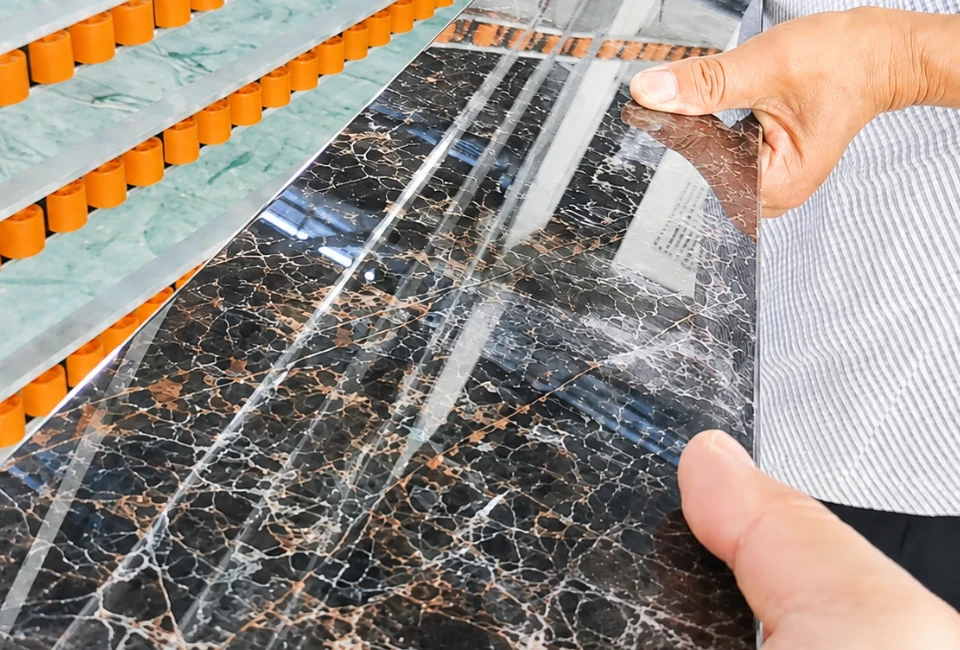
When people admire a luxury marble countertop, a mirror-finished granite island, or a sophisticated sintered stone vanity top, their attention is usually drawn to the color, texture, and design of the material. However, what truly defines the visual quality of a finished stone product is often not the stone itself, but the polishing process applied to its surface.
In modern stone fabrication, polishing is one of the most critical manufacturing stages. It is the process that transforms a rough-cut slab into a premium architectural product capable of meeting the aesthetic and functional expectations of residential, commercial, and hospitality projects. Regardless of how accurately a slab is cut, shaped, or machined, inadequate polishing can significantly reduce its market value.
As stone materials continue to evolve from traditional granite and marble to engineered quartz and ultra-compact sintered stone, polishing technology has become increasingly sophisticated. Today's polishing systems are no longer simple finishing machines. They represent highly engineered manufacturing solutions designed to control surface reflectivity, texture consistency, dimensional accuracy, and production efficiency.
For stone fabricators, understanding the role of polishing within the broader stone processing workflow is essential for achieving both product quality and operational profitability.
If you are unfamiliar with how polishing fits into the complete manufacturing chain, it is worth first exploring the entire Stone Processing Flow before examining the polishing stage in detail.
Why Stone Polishing Is Necessary
Many people assume polishing exists solely to make stone shiny. While visual enhancement is certainly one objective, the true purpose of polishing extends much deeper into the physical characteristics of the material.
Every stone slab, whether natural or engineered, contains microscopic surface irregularities created during cutting, calibration, and shaping operations. Even surfaces that appear smooth to the naked eye contain countless peaks, valleys, and abrasive marks that affect both appearance and performance.
The polishing process systematically removes these imperfections through a controlled sequence of abrasive actions. As progressively finer abrasives interact with the stone surface, the microscopic roughness decreases, allowing light to reflect more uniformly.
This transformation dramatically enhances color saturation, pattern visibility, and overall visual depth. The rich veining of marble becomes more pronounced. The crystalline structure of granite becomes more vibrant. Engineered quartz develops a cleaner and more consistent appearance.
Beyond aesthetics, polishing also contributes to functional performance. A properly polished surface is easier to clean, more resistant to staining, and less likely to trap contaminants within surface irregularities. In commercial and residential applications where hygiene and maintenance are important considerations, these benefits can be as valuable as the visual improvements themselves.
The importance of polishing becomes even more apparent when processing premium materials intended for luxury applications. In many cases, the quality of the polishing process determines whether a product is perceived as a high-end architectural element or a standard construction material.
Where Polishing Fits Within the Stone Processing Workflow
Polishing is not an isolated manufacturing process. It exists as one stage within a larger sequence of stone fabrication operations.
A typical stone slab first undergoes block cutting and slab production at the quarry or slab manufacturing facility. Once the slab reaches a fabrication workshop, it is inspected, measured, and prepared for production.
Cutting operations then establish the basic dimensions and geometry of the final product. Depending on the project requirements, this stage may involve bridge saws, waterjet cutting machines, CNC stone machining centers, or a combination of multiple technologies.
Following cutting and shaping, additional operations such as sink cutouts, faucet holes, drainage grooves, edge profiling, and decorative machining may be performed.
Only after these manufacturing processes have been completed does polishing begin.
This sequence is important because polishing is essentially a refinement process. If dimensional errors or machining defects remain on the workpiece, polishing cannot correct them efficiently. Instead, it enhances the quality of the surface that already exists.
For this reason, leading stone manufacturers view polishing not as an independent operation, but as an integrated component of the entire stone processing workflow.
The Science Behind Stone Polishing
At its core, stone polishing is a process of controlled abrasion.
The goal is not simply to remove material, but to remove it in a highly predictable manner. Each polishing stage utilizes abrasives with specific grit sizes designed to gradually refine the surface texture.
Coarser abrasives eliminate saw marks, machining traces, and surface irregularities. Intermediate abrasives smooth the remaining texture while reducing visible scratches. Fine abrasives create the uniform microstructure necessary for light reflection. Ultra-fine polishing stages then maximize gloss and visual clarity.
What makes stone polishing particularly challenging is that different materials respond differently to abrasion.
Granite contains extremely hard mineral crystals that require aggressive abrasive systems. Marble is comparatively softer and can achieve high gloss levels more easily. Quartz combines hardness with engineered consistency, requiring carefully optimized polishing parameters. Sintered stone presents an entirely different challenge due to its dense, low-porosity structure and advanced ceramic composition.
These material differences explain why polishing technology has become increasingly specialized in recent years.
Stone Materials That Require Polishing
Not every stone product requires the same level of polishing, but most architectural stone applications involve some form of surface refinement.
Granite countertops remain among the most common polished stone products. The polishing process enhances the natural crystalline structure of granite while improving stain resistance and overall durability.
Marble products also rely heavily on polishing to maximize visual appeal. The depth and elegance associated with premium marble surfaces are largely a result of highly refined polishing techniques.
Quartz surfaces require polishing to achieve the uniform gloss and consistency expected in modern kitchens and bathrooms. Because quartz is engineered rather than naturally occurring, polishing must balance surface reflectivity with color consistency.
Sintered stone has become one of the fastest-growing materials in the industry. Although many sintered stone products arrive from manufacturers with factory-finished surfaces, fabrication operations often require edge polishing, cutout finishing, and local surface refinement after machining.
Architectural wall panels, commercial flooring systems, reception desks, vanity tops, furniture surfaces, and decorative stone elements may all require specialized polishing procedures depending on project specifications.
Modern Stone Polishing Machines
The increasing complexity of modern stone materials has driven significant innovation in polishing equipment.
Traditional manual polishing methods remain common in smaller workshops, but industrial manufacturers increasingly rely on automated stone polishing machines to achieve consistency and productivity.
Modern polishing systems typically utilize multiple polishing heads arranged in sequence. As the workpiece passes through the machine, each polishing head performs a specific stage of surface refinement.
This automated approach offers several advantages over manual polishing. Surface consistency improves significantly. Labor requirements decrease. Production throughput increases. Most importantly, quality becomes more predictable.
Today's stone polishing machines are capable of processing granite, marble, quartz, and sintered stone with remarkable efficiency. Advanced control systems automatically adjust pressure, speed, and polishing parameters to optimize results for different materials.
For manufacturers seeking large-scale production capabilities, investing in a dedicated Stone Polishing Machine often becomes essential for maintaining competitiveness.
The Rise of Automatic Polishing Systems
Automation has become one of the defining trends in stone fabrication.
Automatic polishing systems reduce operator dependency while increasing production consistency. Rather than relying on individual craftsmanship, manufacturers can achieve standardized results across large production volumes.
This transition is particularly important as labor shortages continue to affect stone fabrication industries worldwide.
Automated polishing equipment also enables better integration with digital manufacturing workflows. Production scheduling, material tracking, and quality control systems can all be connected to polishing operations, creating a more efficient manufacturing environment.
As stone fabrication continues moving toward smart factory concepts, polishing machines are increasingly becoming part of fully integrated production lines.
Stone Polishing Machines vs CNC Stone Machining Centers
One of the most common questions among fabricators involves the relationship between polishing machines and CNC stone machining centers.
Although both technologies interact directly with stone surfaces, their objectives are fundamentally different.
A stone polishing machine is designed primarily for surface refinement. Its purpose is to improve gloss, texture, and appearance across large areas or finished edges. It excels at creating consistent surface quality and maximizing production efficiency.
A CNC stone machining center, by contrast, is a shaping and material removal system. Its primary role involves cutting, profiling, engraving, drilling, pocketing, and creating three-dimensional features.
The distinction is important because many new fabricators mistakenly assume CNC machines can replace dedicated polishing equipment.
In reality, CNC machines are highly effective for creating geometry but relatively inefficient for large-scale polishing operations. While CNC systems can perform localized polishing and edge finishing, they are not optimized for continuous surface refinement across entire slabs.
Similarly, polishing machines cannot replace CNC machining centers because they lack the ability to create complex shapes, cutouts, and decorative features.
The two technologies are complementary rather than competitive.
When Is a Stone Polishing Machine the Better Choice?
Dedicated polishing machines become the preferred solution whenever surface quality and production efficiency are the primary objectives.
Factories producing large volumes of countertops, flooring materials, wall panels, or commercial stone products benefit significantly from automated polishing systems.
The ability to process large surfaces quickly and consistently provides substantial productivity advantages compared to CNC-based polishing methods.
Polishing machines are also essential when manufacturers require uniform gloss levels across multiple products. Consistency becomes increasingly important in commercial projects where visual differences between panels can negatively impact perceived quality.
When Is a CNC Stone Machining Center the Better Choice?
CNC machining centers become more valuable when geometry creation is the primary objective.
Complex edge profiles, sink cutouts, decorative engravings, drainage grooves, integrated basins, and three-dimensional stone features all require CNC capabilities.
For custom fabrication projects involving unique designs or highly detailed machining operations, CNC systems provide flexibility that dedicated polishing machines cannot achieve.
In many workshops, CNC machines perform the shaping operations while polishing systems handle the final surface finishing stage.
This division of labor allows each technology to operate within its area of greatest efficiency.
Integrating Polishing into a Modern Stone Production Line
The most advanced stone fabrication facilities no longer view polishing as a standalone process.
Instead, polishing is integrated into a broader manufacturing ecosystem that includes slab handling systems, bridge saws, waterjet cutting machines, CNC machining centers, edge processing equipment, and automated material transport solutions.
A typical production workflow may begin with slab cutting, followed by shaping and profiling operations. The workpiece then moves through edge finishing and surface polishing stages before final inspection and packaging.
This integrated approach minimizes material handling, reduces production bottlenecks, and improves overall factory efficiency.
For manufacturers planning future investments, understanding how polishing interacts with the entire Stone Processing Flow is often more important than evaluating individual machines in isolation.
Future Trends in Stone Polishing Technology
The future of stone polishing will likely be shaped by automation, digitalization, and material innovation.
As engineered materials become more advanced, polishing systems will require increasingly sophisticated control algorithms to optimize processing parameters automatically.
Artificial intelligence may eventually enable polishing machines to identify surface defects, adjust polishing pressure dynamically, and predict maintenance requirements before failures occur.
Sustainability will also become a more important consideration. Water recycling systems, energy-efficient motors, and environmentally friendly abrasive technologies are already influencing machine design.
Manufacturers who adopt these technologies early will be better positioned to meet both customer expectations and evolving industry standards.
Conclusion
Polishing is far more than the final cosmetic step in stone fabrication. It is a highly engineered manufacturing process that directly influences appearance, durability, hygiene, customer perception, and product value.
From granite and marble to quartz and sintered stone, polishing plays a crucial role in unlocking the full potential of modern stone materials. Whether performed using dedicated stone polishing machines or integrated into broader production workflows, the process remains one of the most important stages in the entire fabrication chain.
While CNC stone machining centers excel at shaping, profiling, and creating complex geometries, dedicated polishing machines provide the efficiency, consistency, and surface quality required for industrial-scale production. The most successful stone manufacturers understand that these technologies are not alternatives but complementary tools within a complete manufacturing system.
As automation continues to reshape the stone industry, polishing technology will remain at the center of quality-driven production. For fabricators seeking to improve productivity, enhance product value, and remain competitive in an increasingly demanding market, investing in the right polishing strategy is no longer optional—it is a fundamental requirement for long-term success.