









Starting a stone fabrication business is no longer simply about purchasing a saw and renting a workshop. The modern stone industry has evolved into a highly specialized manufacturing sector where profitability depends on production efficiency, automation capability, material specialization, and operational planning.
The rise of quartz countertops, sintered stone, porcelain slabs, engineered surfaces, and custom architectural stone projects has significantly changed the structure of fabrication businesses worldwide. Customers now expect faster lead times, cleaner finishing quality, tighter tolerances, and increasingly customized designs. At the same time, labor costs continue to rise while competition becomes more aggressive.
As a result, the real cost of starting a stone fabrication business extends far beyond the initial machine purchase.
Factory layout, workflow efficiency, material handling systems, dust and water management, labor structure, digital software integration, and future expansion capability all play critical roles in determining whether a fabrication business becomes profitable or struggles with operational inefficiency.
This is why there is no universal answer to the question of startup cost.
A small custom countertop workshop may begin operating with a relatively modest investment, while a highly automated industrial stone factory may require several million dollars in infrastructure and equipment. More importantly, the cheapest startup model is not always the most profitable in the long term.
Understanding where investment creates real production value is far more important than simply minimizing startup expenses.
The Stone Fabrication Industry Has Changed Dramatically
The traditional image of stone fabrication was built around manual labor. Factories relied heavily on experienced operators using bridge saws, hand polishing tools, pneumatic equipment, and manual measuring systems. Production speed depended largely on worker skill, and quality consistency varied significantly from one project to another.
That manufacturing model still exists in some regions, but it is rapidly becoming less competitive.
Modern fabrication businesses are increasingly driven by CNC automation, digital templating, smart nesting software, robotic material handling, and integrated production workflows. High-end customers now demand complex waterfall islands, invisible seams, integrated sinks, large-format porcelain applications, and precision miter fabrication that cannot be consistently achieved through manual processing alone.
At the same time, material technology has evolved.
Quartz, porcelain slabs, and ultra-compact sintered stone materials are significantly more demanding than traditional granite. These materials require stronger machine structures, more stable motion systems, optimized cooling systems, and highly accurate CNC processing.
Because of these changes, the cost structure of starting a fabrication business today is fundamentally different from what it was ten or fifteen years ago.
The most successful modern factories are not necessarily those with the lowest equipment costs. They are the factories that create efficient, scalable, and repeatable production systems.
The Real Cost Depends on the Type of Fabrication Business
One of the biggest misconceptions in the industry is treating all stone fabrication businesses as identical operations.
In reality, startup costs vary dramatically depending on the business model.
A small residential countertop workshop operates under completely different conditions compared to a commercial stone contractor or a large industrial quartz processing factory. The type of customer, material focus, production volume, and labor structure all influence investment requirements.
Small custom fabrication shops often prioritize flexibility over production speed. These businesses typically process marble, granite, and quartz kitchen projects for local residential markets. Their daily slab volume is relatively low, and production relies heavily on customization.
In this type of operation, the initial investment may focus primarily on a CNC bridge saw, polishing equipment, dust control systems, and a basic material handling setup.
A medium-sized fabrication factory usually requires a more integrated workflow. These companies often process both residential and commercial projects while managing higher slab throughput. Production consistency becomes increasingly important because project delays directly affect profitability.
At this stage, investment usually expands into dedicated stone CNC machines, digital templating systems, vacuum lifting systems, slab storage solutions, and more advanced workflow management.
Large industrial fabrication facilities operate on an entirely different scale. Their focus is high-volume standardized production with minimal labor dependency. These factories often specialize in quartz countertops, prefab production, or large commercial projects.
In these environments, startup investment includes automated loading systems, multiple CNC production cells, robotic handling systems, intelligent material tracking, and highly optimized production flow design.
The difference in startup cost between these factory models can be enormous.
Equipment Is the Largest Investment Category
For most fabrication businesses, machinery represents the single largest startup expense.
However, many new factory owners make the mistake of evaluating machines purely based on price instead of production compatibility.
The cheapest equipment often creates the highest operational cost over time through slower production, inconsistent quality, higher labor dependency, increased maintenance, and poor scalability.
The foundation of most fabrication shops is the bridge saw.
A modern bridge saw designed for countertop fabrication is far more advanced than traditional slab cutting equipment. High-end systems now incorporate 5-axis interpolation cutting, automatic blade tilting, contour processing, miter cutting, and CAD/CAM integration.
For businesses processing quartz or porcelain slabs, machine rigidity becomes especially important. Weak structures generate vibration during cutting, leading to edge chipping, inaccurate dimensions, and accelerated tool wear.
This is why serious fabrication businesses increasingly invest in CNC bridge saw systems rather than manual equipment.
The second major investment category is the stone CNC machine.
Modern customers increasingly demand integrated sinks, drain grooves, curved edges, custom cutouts, and precision finishing. These operations are difficult to perform consistently with manual processing methods.
A dedicated CNC machining center improves repeatability while reducing labor intensity. More importantly, it allows businesses to handle higher-value projects that would otherwise be difficult to fabricate efficiently.
Waterjet systems represent another major investment consideration.
Although not every fabrication business requires waterjet technology initially, companies specializing in porcelain, medallions, luxury inlays, or intricate architectural stone often benefit significantly from waterjet capability. Waterjet cutting minimizes thermal stress while enabling extremely precise contour cutting.
The investment level therefore depends heavily on production specialization.
Factory Infrastructure Is Often Underestimated
Many first-time investors focus almost entirely on machinery while underestimating infrastructure requirements.
In reality, factory infrastructure can consume a substantial portion of the total startup budget.
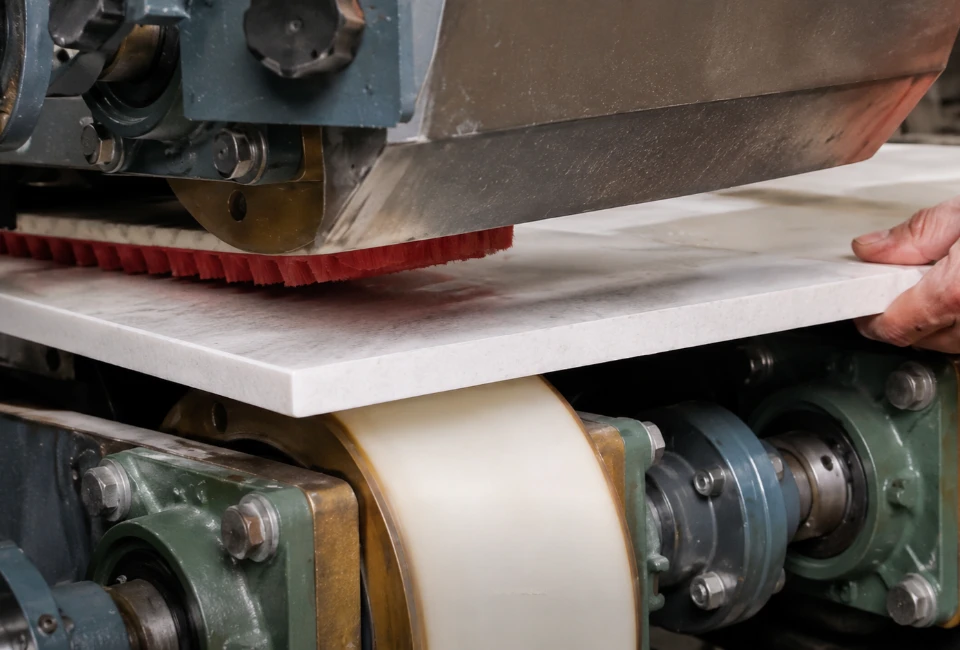
Stone fabrication requires large open production areas, reinforced flooring, water recycling systems, electrical capacity, dust management systems, slab storage space, and material handling zones.
Poor factory layout creates operational bottlenecks that directly reduce productivity.
For example, inefficient slab movement between cutting, CNC processing, polishing, and packaging stations can significantly increase labor time and material risk.
The physical structure of the factory also matters.
Processing large-format porcelain slabs requires stable floors, sufficient overhead clearance, and carefully planned handling systems. Heavy slab storage introduces additional structural considerations.
Water and dust management systems are especially important.
Modern fabrication facilities consume large volumes of cooling water during cutting and polishing operations. Without effective recycling systems, operating costs can increase rapidly. Dust management is equally critical because silica dust exposure has become a major regulatory concern in many countries.
Factories designed without proper environmental and safety planning may face serious operational limitations later.
Labor Structure Has Become a Critical Financial Factor
Labor costs have become one of the most important economic pressures in the stone industry.
Traditionally, fabrication businesses relied heavily on skilled workers with years of manual processing experience. However, skilled labor is becoming increasingly difficult to recruit in many regions.
This shift is one of the main reasons why automation investment has accelerated globally.
A highly automated fabrication line may require larger upfront investment, but it often reduces long-term operating costs by improving consistency and reducing labor dependency.
The relationship between labor and automation is particularly important when evaluating startup strategy.
A low-cost manual factory may appear financially attractive at first, but rising labor costs can quickly erode profitability. In contrast, a more automated production system may generate stronger long-term scalability even with higher initial investment.
This is especially true for businesses targeting high-volume quartz countertop production.
Automation also reduces operational risk.
Factories that depend heavily on a small number of highly skilled operators become vulnerable when those employees leave. Digitized CNC workflows help standardize production knowledge and reduce reliance on individual craftsmanship.
The ideal balance between labor and automation depends on local wage structure, project volume, and production goals.
Material Type Significantly Affects Investment Requirements
Not all stone materials require the same production capability.
Granite fabrication typically places greater emphasis on cutting power and tool durability. Marble processing often requires precision finishing and careful handling due to material fragility.
Quartz production introduces higher abrasive wear and increased throughput demands.
Porcelain and sintered stone create an entirely different manufacturing challenge.
These materials are extremely hard but relatively brittle, especially in thin slab formats. Processing them effectively requires stable machine structures, optimized tooling systems, advanced motion control, and reduced vibration.
As the market shifts toward porcelain and engineered surfaces, many fabrication businesses are forced to upgrade equipment earlier than expected.
This is one reason why future material trends should influence startup planning from the beginning.
A factory designed only for traditional granite production may struggle to compete in future countertop markets dominated by quartz and porcelain surfaces.
Cheap Factories Often Become Expensive Factories
One of the most common mistakes among new fabrication businesses is minimizing startup investment without considering long-term operational efficiency.
Cheap machines often produce slower workflows, inconsistent quality, increased downtime, and higher maintenance frequency. These hidden operational costs accumulate over time.
Low-cost production layouts can also create severe workflow inefficiencies.
For example, poorly organized material flow increases slab handling frequency, labor movement, and breakage risk. In stone fabrication, material damage can become extremely expensive because a single damaged quartz slab may represent a substantial financial loss.
Similarly, underinvesting in automation may initially reduce startup costs but later create production bottlenecks that limit growth potential.
The goal should not be building the cheapest factory possible.
The goal should be building the most sustainable and scalable production system within the available budget.
Long-term profitability is determined by production efficiency rather than startup cost alone.
Different Investment Strategies for Different Factory Models
There is no universally correct way to start a fabrication business.
Some entrepreneurs begin with a compact workshop focused on custom residential projects. This model offers lower startup risk while allowing gradual expansion over time.
Others enter the market with highly automated production systems designed for large-scale commercial fabrication and industrial throughput.
Both strategies can succeed under the right market conditions.
Small custom fabrication shops often benefit from versatility. A flexible production setup capable of handling granite, marble, quartz, and porcelain allows these businesses to adapt to changing customer demand.
Medium-sized factories usually focus on balancing customization with throughput efficiency. These companies often achieve strong profitability by combining CNC automation with selective manual craftsmanship.
Large industrial fabrication plants prioritize process standardization, labor optimization, and production scalability.
The best startup strategy depends on market positioning, regional demand, customer structure, competition level, and available capital.
The most important factor is aligning investment decisions with realistic production goals.
The Future of Stone Fabrication Investment
The future of stone fabrication is becoming increasingly digital, automated, and data-driven.
Artificial intelligence, robotic material handling, digital production tracking, predictive maintenance, and smart factory management are gradually becoming part of modern fabrication operations.
At the same time, customer expectations continue to rise.
Architectural projects increasingly require thinner materials, larger slab formats, more precise detailing, and shorter delivery schedules. These trends place greater pressure on factory efficiency and machine capability.
Environmental regulations are also reshaping the industry.
Water recycling, dust suppression, energy efficiency, and sustainable manufacturing practices are becoming important investment considerations for fabrication businesses worldwide.
As a result, the future competitiveness of a fabrication business depends less on simply owning machines and more on building an integrated manufacturing system capable of adapting to technological change.
Factories that invest strategically in workflow efficiency, automation compatibility, and scalable infrastructure are more likely to remain competitive in the coming decade.
Estimating the Right Investment for Your Factory
Because every fabrication business operates under different conditions, estimating startup cost requires more than simply calculating machine prices.
Production volume, factory size, material focus, labor structure, automation level, regional labor cost, utility infrastructure, and target market all influence the total investment requirement.
A small custom countertop workshop may require a completely different equipment strategy compared to a high-volume quartz processing factory or an architectural stone production facility.
This is why many investors now use digital planning tools before finalizing factory layouts and equipment configurations.
A professional investment planning approach helps identify potential bottlenecks, estimate production capacity, compare automation levels, and evaluate long-term operational efficiency before major purchasing decisions are made.
If you are planning to build or upgrade a fabrication facility, using a dedicated stone fabrication factory investment calculator can provide a more realistic understanding of equipment requirements, factory scale, workflow configuration, and estimated investment range based on your specific production goals.