









Introduction: The Complexity Behind Modern Stone Cutting
In the modern stone fabrication industry, cutting technology has evolved from traditional manual craftsmanship into a highly automated and digitally controlled manufacturing system. CNC machines, waterjet cutting systems, multi-axis machining centers, and intelligent nesting software now dominate production environments.
However, despite these technological advances, stone cutting processing still presents a wide range of complex and persistent technical challenges. Unlike homogeneous industrial materials such as metals or plastics, stone materials exhibit strong internal variability. Natural granite, marble, quartzite, and engineered stone all contain irregular mineral structures, microfractures, density variations, and anisotropic mechanical properties.
Because of this, stone cutting problems are rarely caused by a single factor. Instead, they result from the interaction of material behavior, machine rigidity, cutting tools, process parameters, and environmental conditions. Understanding these issues from a system-level engineering perspective is essential for achieving stable, high-quality production.
Micro Edge Chipping and Stress Fracture Propagation
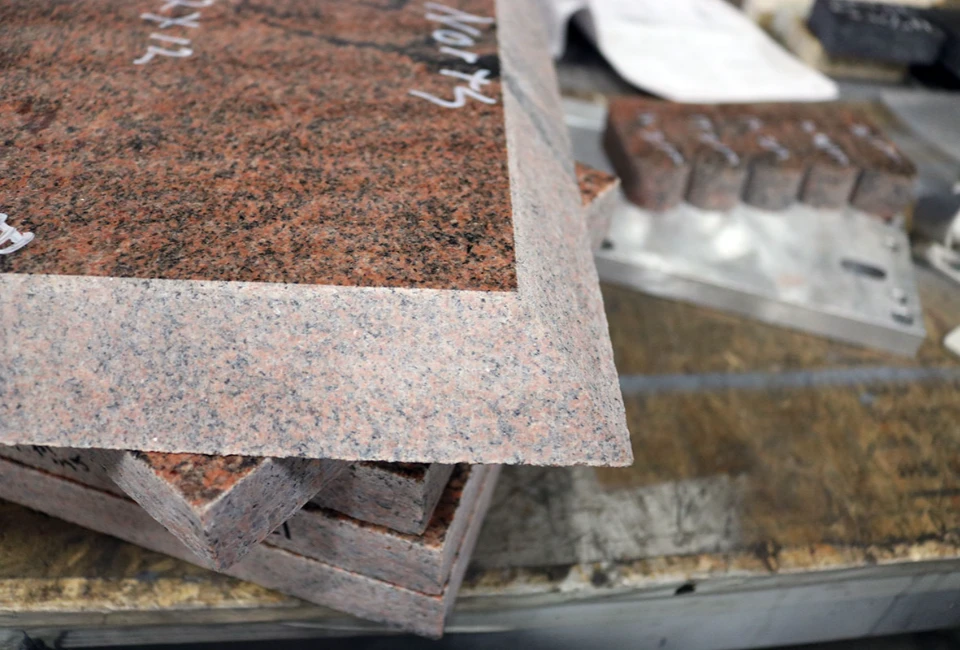
One of the most common yet underestimated issues in stone cutting is micro-edge chipping. At first glance, the cut surface may appear clean and complete, but under closer inspection—especially during installation or seam alignment—tiny fractures or edge breakouts become visible.
These defects are not necessarily caused by dull tools. In many cases, they originate from uneven stress distribution during cutting. When a cutting tool or waterjet penetrates stone material, internal stress waves propagate through the crystalline structure. If stress release occurs too rapidly, microscopic cracks expand outward from the cutting edge.
This issue is particularly severe in high-hardness materials such as granite or high-quartz engineered stone. Simply reducing cutting speed does not effectively solve the problem, because it does not address stress concentration behavior.
A more advanced solution is to redesign the cutting process as a controlled stress-release system. Instead of performing a single full-depth cut, a staged cutting strategy can be used. A shallow pre-cut groove is first created to guide stress distribution, followed by gradual depth cutting. In addition, optimizing tool path acceleration curves helps reduce sudden force impact, significantly improving edge stability.
Dimensional Accuracy Deviation and Accumulation Error
Another critical issue in stone cutting processing is cumulative dimensional deviation. Although CNC systems provide high theoretical precision, real-world machining environments still introduce multiple sources of error.
These include linear guide wear, servo system lag, tool deflection under load, thermal expansion of machine components, and slight deviations in high-pressure waterjet trajectories. While each individual error may be small, they accumulate over long production cycles.
This becomes especially problematic in large-format applications such as kitchen countertops, stair treads, and architectural façade panels, where even millimeter-level deviations can lead to installation misalignment.
The most effective solution is not static calibration but dynamic compensation. Modern production systems increasingly rely on real-time feedback loops that continuously adjust tool paths during operation. By integrating motion control systems with sensor data and predictive algorithms, manufacturers can reduce cumulative deviation across entire production batches.
Waterjet Cutting Taper and Verticality Control Challenges
In waterjet cutting systems, one of the most technically challenging issues is taper formation. Because abrasive waterjets lose energy as they penetrate deeper into the material, the resulting cut often exhibits a geometric deviation where the top and bottom widths differ.
This phenomenon becomes more pronounced in thicker stone slabs or composite materials. While reducing cutting speed can improve verticality, it also reduces productivity and increases cost.
A more advanced approach involves three-dimensional compensation modeling combined with dynamic pressure control. By adjusting jet pressure, cutting angle, and traverse speed in real time, the system can counteract natural energy decay.
Some advanced CNC waterjet systems also use inverse taper compensation algorithms, where tool paths are intentionally offset so that final geometry becomes vertically accurate after material removal. This represents a shift from reactive correction to predictive process optimization.
Internal Material Defects and Unexpected Fracture Behavior
Stone materials often contain hidden internal structures such as microcracks, mineral veins, or weak bonding zones. These defects are not visible on the surface but can significantly affect cutting performance.
During machining, these weak zones may cause unexpected crack propagation that deviates from the intended cutting path. In severe cases, entire slabs may fracture unpredictably, resulting in significant material loss.
This issue is particularly critical in high-value stone processing. Unlike machine-related problems, it cannot be solved through parameter adjustment alone.
Instead, pre-processing material analysis becomes essential. Advanced fabrication facilities increasingly use non-destructive testing methods such as ultrasonic scanning, infrared imaging, or structural mapping systems. By identifying internal weaknesses before cutting, operators can optimize layout planning and avoid placing critical cuts in high-risk zones.
Multi-Process Accumulation Deviation in Complex Fabrication
In high-end stone applications such as decorative panels, customized countertops, and artistic mosaics, parts often undergo multiple processing stages including cutting, edge profiling, polishing, and assembly.
Each stage introduces small deviations. When combined across multiple machines or production lines, these deviations can accumulate into noticeable misalignment during final installation.
This issue becomes more severe in environments where different machines operate with independent coordinate systems. Without unified reference control, even high-precision equipment cannot guarantee consistent assembly accuracy.
The solution lies in building a unified digital manufacturing framework. All machines must operate under a shared coordinate system linked to a central digital model. Additionally, closed-loop production control allows each processing stage to compare output against design intent and apply corrections in real time.
Thermal Effects in High-Speed Stone Cutting
Although stone is less sensitive to heat compared to metals, thermal effects still play an important role in high-speed or dry cutting processes. Localized temperature increases can alter the behavior of resin-based engineered stone materials.
When temperature rises, resin components may soften slightly, leading to uneven cutting resistance and surface waviness. This is particularly noticeable in quartz stone processing.
To address this, thermal management must be integrated into the cutting process. Techniques such as high-pressure mist cooling, intermittent cutting strategies, and feed rate modulation help maintain stable temperature conditions. By controlling thermal accumulation, manufacturers can achieve more consistent surface quality.
Machine Vibration and Structural Resonance Issues
Another often overlooked issue is machine vibration and structural resonance. During long-term high-load operation, machine frames may develop micro-vibrations due to fatigue or structural stress.
At high cutting speeds, these vibrations can be amplified, resulting in wave-like patterns on cut surfaces. Many operators mistakenly attribute this to software or tool problems, when in fact the root cause is mechanical resonance.
Solving this issue requires a system-level approach. Machine foundation reinforcement, vibration damping systems, and parameter optimization must be considered together. Only by aligning structural dynamics with cutting conditions can stable machining quality be achieved.
AI Nesting Optimization and Efficiency-Stability Trade-offs
With the rise of intelligent manufacturing, AI-based nesting and cutting optimization systems are increasingly used in stone fabrication. These systems significantly improve material utilization rates but also introduce new challenges.
In some cases, optimization algorithms prioritize material efficiency too aggressively, resulting in overly complex cutting paths. This increases tool load, amplifies vibration, and reduces process stability.
To resolve this, manufacturers must adopt constraint-based optimization models. These models balance material utilization with machining stability, structural load distribution, and process reliability. Efficiency must be evaluated alongside stability rather than in isolation.
Conclusion: Stone Cutting as a System Engineering Problem
In conclusion, stone cutting processing challenges are not isolated technical issues but multi-factor system problems. They arise from the interaction between material heterogeneity, machine limitations, process design, and environmental influences.
High-level stone fabrication is therefore defined not only by advanced equipment but by the ability to understand and control the entire production system. The future of the industry lies in digital integration, predictive process control, and intelligent adaptation to material behavior.