










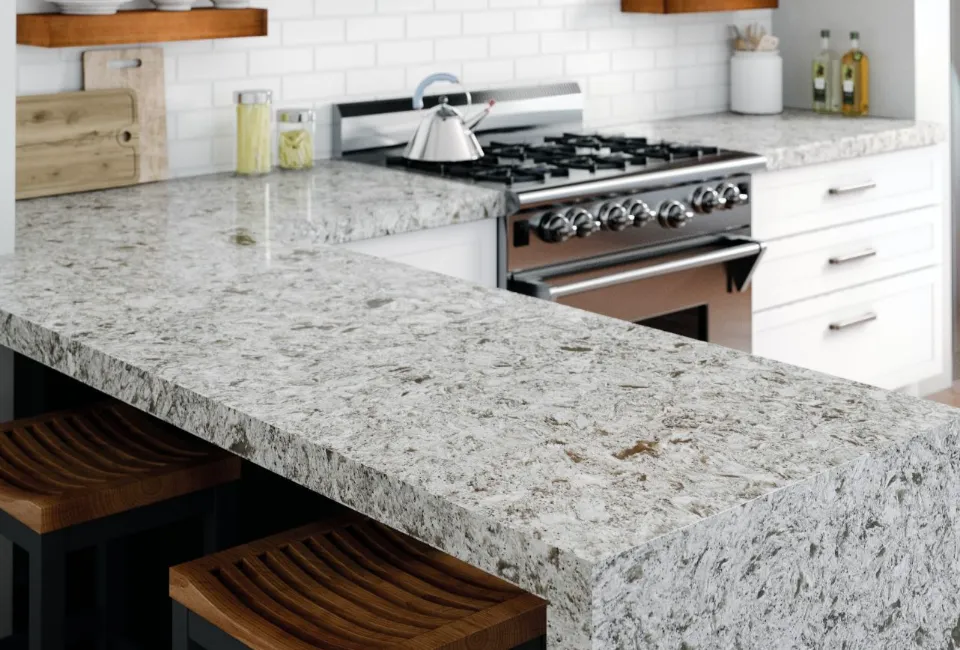
The kitchen countertop industry has evolved far beyond traditional stone cutting. Modern fabrication is no longer defined only by the ability to cut slabs into shapes. Today, countertop manufacturers are expected to deliver higher precision, shorter lead times, cleaner finishes, and increasingly complex designs while maintaining profitability in a highly competitive market.
As quartz, sintered stone, porcelain slabs, and engineered surfaces continue to dominate architectural and interior projects, the demand for advanced stone CNC machine and bridge saw for countertops solutions has increased significantly. At the same time, labor shortages, rising material costs, and customer expectations are forcing fabricators to rethink how their factories operate.
This is why choosing the right countertop fabrication equipment is no longer a simple purchasing decision. It is a strategic decision that directly affects production efficiency, material utilization, product quality, labor dependency, and long-term scalability.
The best machine for one factory may be completely unsuitable for another. A small custom countertop workshop has very different operational priorities compared to a high-volume automated countertop plant. Likewise, fabricators specializing in luxury marble projects face different technical challenges than factories processing quartz or ultra-compact porcelain surfaces.
Understanding these differences is essential before investing in countertop manufacturing equipment.
The Evolution of Kitchen Countertop Manufacturing
Traditional countertop fabrication relied heavily on manual labor. Operators used basic bridge saws, hand polishing tools, and mechanical templates to process stone slabs. While this method worked for decades, it created several limitations. Production speed depended almost entirely on operator experience. Precision varied from project to project. Complex shapes required significant manual adjustments. Material waste was often high, especially when cutting expensive quartz or marble slabs.
The rise of CNC automation changed the entire industry.
Modern stone CNC machine systems can now perform cutting, profiling, drilling, slotting, sink hole processing, edge shaping, and polishing with extremely high consistency. Combined with CAD/CAM software and digital templating systems, fabricators can produce countertops with significantly improved repeatability and accuracy.
At the same time, the role of the bridge saw for countertops has also changed. High-end bridge saws are no longer simple cutting machines. Today’s 5-axis CNC bridge saws integrate interpolation cutting, automatic tilting, miter cutting, contour shaping, and smart nesting capabilities into a single system.
As countertop materials become harder, thinner, and more expensive, machine precision and motion stability become increasingly important.
Why Machine Selection Depends on Factory Type
One of the biggest mistakes in countertop manufacturing is purchasing equipment based purely on machine specifications instead of production structure.
A machine that performs exceptionally well in a fully automated industrial environment may become inefficient inside a small custom fabrication shop. Similarly, entry-level equipment may become a bottleneck in medium or large-scale production.
Small countertop workshops usually prioritize flexibility and investment control. These businesses often process custom kitchen projects with varying dimensions and relatively low daily slab throughput. For them, a compact CNC bridge saw with automatic programming functions may provide the best balance between cost and production capability.
Medium-sized countertop manufacturers typically require a combination of productivity and flexibility. These factories usually handle both residential and commercial projects while maintaining moderate production volume. Their production systems often benefit from combining a bridge saw for countertops with a dedicated stone CNC machine for sink processing, edge shaping, and complex fabrication tasks.
Large industrial countertop factories operate under entirely different conditions. Their primary challenge is maintaining continuous throughput while minimizing labor dependency. In these environments, integrated automation systems become more valuable than standalone machines. Multi-machine production cells, robotic loading systems, automatic labeling, and smart material flow management can significantly improve efficiency.
The ideal equipment strategy therefore depends less on machine popularity and more on production philosophy.
The Role of the Bridge Saw for Countertops
Despite the rapid growth of CNC machining centers, the bridge saw remains the foundation of most countertop factories.
A high-quality bridge saw for countertops is responsible for primary slab cutting, dimensional accuracy, miter preparation, and large-format material handling. In many fabrication workflows, the bridge saw determines the overall rhythm of production.
However, not all bridge saws are designed for modern countertop processing.
Entry-level manual bridge saws may still be suitable for basic granite cutting, but they struggle with modern quartz surfaces and porcelain slabs where precision and edge quality are critical. Manual positioning systems also reduce productivity and increase operator dependency.
Modern CNC bridge saw systems solve many of these limitations.
A 5-axis bridge saw allows fabricators to perform angled cuts, sink openings, curved cuts, drain grooves, and miter joints with significantly higher precision. Automatic head rotation and blade tilting reduce setup time while improving consistency between projects.
This becomes especially important when processing waterfall countertops, invisible joints, and luxury kitchen islands where dimensional errors become highly visible after installation.
The rigidity of the machine structure also plays a major role. Lightweight bridge saws often generate vibration during high-speed cutting, especially when processing dense quartz materials. This vibration can create edge chipping, inaccurate dimensions, and accelerated tool wear.
High-end bridge saw systems typically use reinforced steel structures, servo-driven motion systems, and advanced interpolation control to improve stability.
For factories focusing heavily on quartz countertops, machine rigidity often matters more than maximum cutting speed.
Why Stone CNC Machines Are Becoming Essential
While bridge saws handle slab separation and primary cutting, the stone CNC machine has become the center of modern countertop customization.
Contemporary countertop projects increasingly require integrated sinks, invisible drain systems, complex edge profiles, precision cutouts, and custom design features. These operations are difficult to achieve consistently using only bridge saws.
A stone CNC machine provides the flexibility required for advanced fabrication.
Unlike traditional cutting equipment, CNC machining centers can perform multiple operations within a single automated workflow. This reduces repositioning errors while improving repeatability.
For example, a countertop slab can move directly from rough cutting into sink hole processing, faucet drilling, edge shaping, and polishing without requiring multiple manual setups.
This integration improves both precision and labor efficiency.
The importance of CNC systems becomes even greater when processing porcelain slabs and sintered stone materials. These materials are extremely hard but relatively brittle. Improper machining parameters can easily create edge fractures or micro-cracks.
Advanced CNC systems help address these challenges through intelligent feed rate control, servo synchronization, and optimized toolpath management.
For high-end countertop manufacturers, CNC capability is no longer considered optional. It has become a core production requirement.
Quartz Countertops Require Different Equipment Priorities
Quartz countertop manufacturing introduces a completely different set of technical demands compared to natural stone processing.
Unlike granite or marble, quartz materials contain engineered resin structures combined with extremely dense mineral particles. This makes quartz highly abrasive while also sensitive to thermal stress during cutting.
As a result, countertop fabrication equipment designed for granite may not perform effectively when processing quartz.
Factories specializing in quartz countertops typically benefit from machines with stronger spindle systems, improved cooling control, and more stable motion structures.
Blade quality and cutting parameters become particularly important. Inadequate spindle stability or poor servo synchronization often causes edge chipping, especially on polished quartz surfaces.
Quartz production also places greater emphasis on throughput efficiency. Because quartz is widely used in mass-market residential projects, production volume tends to be significantly higher compared to luxury marble fabrication.
This is why many quartz factories prioritize automation features such as automatic loading systems, digital templating integration, and smart nesting software.
Material utilization also becomes critical because quartz slabs are expensive and relatively standardized in size. Optimized nesting can significantly reduce waste and improve profitability.
In high-volume quartz production, software integration often becomes just as important as machine hardware.
Porcelain and Sintered Stone Are Changing Equipment Standards
One of the most important developments in modern countertop manufacturing is the rapid growth of large-format porcelain and sintered stone surfaces.
These materials are transforming machine requirements across the entire industry.
Porcelain slabs are extremely hard and dimensionally stable, but they are also fragile during processing. Their thin thickness combined with high internal density creates serious challenges for traditional cutting equipment.
Machines originally designed for thick granite slabs may generate excessive vibration when processing ultra-thin porcelain materials.
This is why specialized bridge saw for countertops systems increasingly incorporate vacuum stabilization tables, advanced interpolation algorithms, and adaptive cutting technologies.
Waterjet integration is also becoming more common in porcelain fabrication because it reduces thermal stress and minimizes chipping risk during intricate cutting operations.
For factories planning long-term investment strategies, machine compatibility with porcelain and sintered stone processing is becoming increasingly important.
A machine optimized only for traditional granite production may become obsolete as market demand shifts toward engineered surfaces.
Automation Is Reshaping Countertop Factories
Automation in countertop manufacturing is no longer limited to large industrial corporations.
Even medium-sized fabrication shops are beginning to adopt automated workflows to reduce labor dependency and improve consistency.
Labor shortages have become a global issue within the stone industry. Skilled operators are increasingly difficult to recruit and retain. At the same time, modern customers expect faster project delivery and higher finish quality.
Automation addresses both problems simultaneously.
Modern countertop fabrication equipment can integrate with digital measuring systems, barcode tracking, robotic loading units, and factory management software.
This creates a connected production environment where slabs move through fabrication stages with minimal manual intervention.
The advantages extend beyond labor reduction.
Automation also improves repeatability, reduces human error, minimizes material waste, and creates more predictable production timelines.
However, automation should not be approached blindly.
A fully automated production line may generate excellent efficiency in a high-volume factory but create unnecessary complexity in a low-volume custom workshop.
The best automation strategy is usually incremental. Factories should first identify their production bottlenecks before investing in advanced automation systems.
In many cases, upgrading from manual cutting to a CNC bridge saw already creates dramatic operational improvements.
Choosing Equipment Based on Production Strategy
Many countertop manufacturers focus too heavily on machine specifications while ignoring workflow compatibility.
Maximum spindle power, cutting speed, or axis travel are important, but they are meaningless if the machine does not fit the factory’s actual production structure.
Equipment selection should begin with production analysis.
Factories focused on luxury custom kitchens may prioritize precision, flexibility, and finish quality. Their ideal setup may include a high-end 5-axis bridge saw combined with a compact CNC machining center.
Factories focused on mass quartz production may prioritize throughput, automation, and slab handling efficiency. These businesses often benefit from integrated production lines with automatic loading and optimized nesting systems.
Fabricators specializing in porcelain slabs require machines optimized for vibration control and brittle material processing.
Small fabrication shops often benefit from versatile all-in-one systems capable of handling multiple operations without requiring large infrastructure investment.
There is no universal “best machine” for every countertop factory.
The best solution is always the one that aligns machine capability with production goals, labor structure, material focus, and future growth plans.
The Future of Countertop Fabrication Equipment
The countertop industry is entering a new technological phase.
Artificial intelligence, smart software integration, predictive maintenance, robotic handling systems, and digital production management are gradually becoming part of modern stone factories.
At the same time, customer expectations continue to rise.
Architectural projects increasingly demand thinner materials, invisible seams, complex geometries, and customized surface designs. These requirements push countertop fabrication equipment toward higher precision and greater automation.
Sustainability is also influencing machine development. Energy efficiency, water recycling, optimized material utilization, and dust reduction are becoming important considerations for both manufacturers and fabricators.
The factories that remain competitive in the future will not necessarily be the ones with the largest machines. They will be the factories that build efficient, flexible, and digitally connected production systems.
In this environment, choosing the right stone CNC machine or bridge saw for countertops is not simply about cutting stone.
It is about building a manufacturing system capable of adapting to the future of the countertop industry.